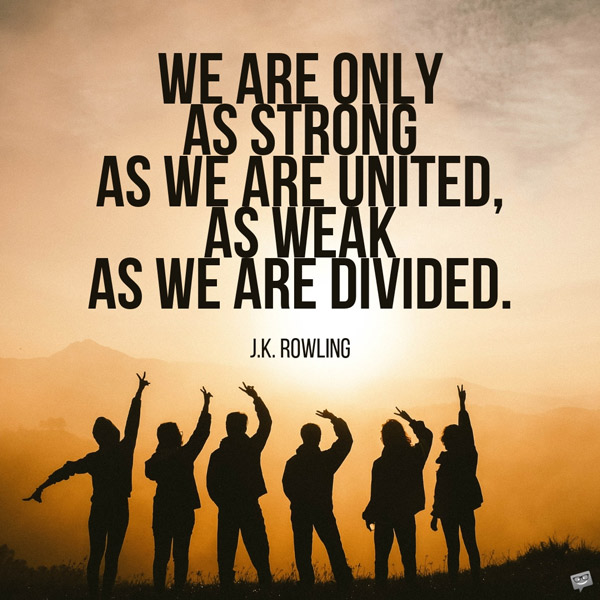
#DailyWritingChallenge Day 43: Unity

noun. the state of being united or joined as a whole.
Unity is being together or at one with someone or something. It’s the opposite of being divided. This is a word for togetherness or oneness.
Before #Covid19:
Our world had become divided. Our society had become disjointed. Our school system had become fragmented. Our individualism has overridden our collective endeavour.
“United we stand, divided we fall”.
Aesop
During Lockdown:
Our communities have become more united. Our shared experience has forged connections and understanding. Our sense of togetherness has been renewed.
“In union there is strength”.
Aesop
After Social Distancing:
Will we remember this experiences and the lessons we are learning? Will we honour this state of being and carry it into our future state? Will we continue as a united front?
“Alone we can do so little; together we can do so much”.
Helen Keller
The pandemic has sent us many messages. The universe has spoken, loud and clear: humanity needs to stop, pause and listen. But what messages are we hearing?
Many of the blog themes in the last few weeks have made me think of a play I used to teach at GCSE: An Inspector Calls by JB Priestley. The ghostly inspector visits, spotlighting death and deception through his supernatural powers of perception and persuasion. The play explores the concept of society.
The drama is a series of revelations and the Inspector is a catalyst for a series of events that unfold with the play ending with the visitor leaving more questions than answers. His presence is felt, and provokes each character into exposing themselves as each has committed a crime which relate to the seven deadly sins. Priestley’s intentions were to reveal to the audience the social state of England in 1945,  as he felt that little had changed since the turn of the century.
The play was written 75 years ago, but so much of this social landscape and his commentary on it resonates today.
J B Priestley believed in socialism, he was a political thinker and the play is a social commentary. The play explores the construct of socialism and proposes the idea of common ownership and suggests that we should all look after one another, that we should serve our communities. The Birling family represent the greed of capitalism, the selfishness of the corporate world and individuals who are self-serving.
Is this Pandemic that uninvited visitor, who has appeared to disrupt the equilibrium by shining a cold, white light on the world, thus forcing us to scrutinise our daily existence?
“Individually, we are one drop. Together, we are an ocean”.
Ryunosuke Satoro
So many parallels can be drawn between this play and our current situation. 
Our current focus is on the Pandemic, on our unwanted guest, but should it in fact be on the cracks that are appearing? The ‘truths’ that are being exposed?
The Government’s plans are around the economy, but should they instead be concerned about humanity?
The countries that have survived this crisis and been left the least damaged by it are the countries which are the most liberal, the countries who place their people, their society and their communities at the centre of their decision making. The focus on wellbeing in these countries does not go unnoticed.
“If you want to go quickly, go alone. If you want to go far, go together”.
African proverb.
We have so much to learn, so much to develop and so much to do differently moving forwards. Will we be the agents of this much needed  social change?
We were competing not collaborating. We were divided. We were separate. We were incohesive.
We are connecting and supporting. We are united. We are a collective voice. We are acting as one. We are cohesive.
We are united by our humanity, for now, but how long will this continue and will we sustain this focus as we come out the other side?
unity 3

#LockdownLeadership Blog 6: ‘Servant Leaders’

The #LockdownLeadership series is a collection of anonymous blogs about leadership during these uncertain times. Share your leadership journeys: confessions… conversations… celebrations… challenges… Reflect on your moments of: courage… compassion… clarity… craziness… Email 500 words to hello@hannah-wilson.co.uk to be shared in this safe space. 

I am ten years out of headship now, and as I observe how schools are adapting and coping in the current challenging circumstances I feel humbled by the dedication leaders at all levels, teachers and school support staff are demonstrating.  While having their own concerns about friends and families, trying to protect their own health and balance personal responsibilities with professional commitments, those who work in schools are stepping up to the plate and showing just what they’re made of.  They manage the tricky balance between providing teaching remotely and caring for those who need supervision in schools while organising their own households.  Many worry about the pupils they do not see, especially those who have difficult home circumstances, being isolated and distanced from the support and stability school usually offers them.  They do what they can to check in and to maintain the important relationships which help pupils to feel connected and not alone.  They control their fear and anxiety and just keep showing up, doing what they can to serve, not just their student populations, but the communities within which they sit.

The pandemic has shown us how important schools are within these communities, and I see schools working with parents and carers more closely than ever before – bolstering and guiding, understanding and empathising.  There is talk of whether society as a whole will have a fuller appreciation of the contributions schools make once this is all behind us and some kind of normality returns.  There is discussion of what we are learning about what matters most, and what the true point of education is, as these extraordinary times encourage everyone to question their values and priorities.  I hope that we are changed for the better by this experience, and that we don’t just revert to our former relationships and old habits: something special is happening in our communities, and the kindness and consideration shown by so many is something that should have an impact well beyond the current lockdown.  Time will tell.

In the meantime, I ask myself how I can show leadership and support those on the front line.  I write about education.  I read a lot written by educators, and I tweet and comment and share.  I pass on information I think might be helpful to those who are juggling so much more than I am.  I receive communications from individuals requesting advice or guidance and I support wherever I can.  I contribute to online professional learning sessions, sharing experiences and thoughts which I hope may encourage others’ reflections as they gauge how they might approach current and future challenges.  I hope to support educators as they filter the potentially overwhelming amount of information out there, encouraging them to pause, take a breath, and make some considered choices, despite the pressure and sense of urgency.  I know that as a school leader I never faced anything this difficult, and I have huge respect and admiration for those who are navigating this.

This is #LockdownLeadership.

#DailyWritingChallenge Day 42: Patience

Patience is the ability to endure difficult circumstances such as perseverance in the face of delay; tolerance of provocation without responding in annoyance/anger; or forbearance when under strain, especially when faced with longer-term difficulties. Patience is the level of endurance one can have before negativity.

Patience is not one of my virtues, or so I have been told, but the irony is I do play Patience when I need to kill time.

I thrive on action… activity… productivity… I like being busy, feeling purposeful and making the most of every minute. If you meet me/ have met, I think fast, I talk fast, I walk fast, I type fast. I am a ball of energy and adrenaline.  Of course I can be patient when I need to be, but I like things turned around quickly, I am a pace setter.

This comes from 18 years of training, 14 of those years in school improvement, as a leader in schools that needed to rapidly improve. If there was no pace, no sense of urgency in our leadership, then the next cohort of Year 11s would be failed too.

I was head hunted for Senior DHT role at a MAT on the South Coast, when I was VP in London for Harris. At interview I was asked: “What would Harris do with a school that had been failing for 3 years?” I was baffled by this question. Eventually I answered: “But Harris wouldn’t let a school fail for 3 years. They would deploy all of their resources into that school, they would prioritise its need”. The interviewer looked shocked. I continued and added: “In all honesty, there is no excuse, and you could redeploy staff from London to come down here for secondments as I know it is hard to recruit”. I was offered the job, with an insulting package, so I declined, but that conversation stays with me.

Yes, Patience is a virtue, but it is not an excuse. We need to be patient with some things, but we also need to prioritise others. If we accept slow rates of change, snail-like paces in improvement, poor prioritisation, that is not us exercising patience, that is us being reckless.

Leaving a role in a school where time was frenetic, every minute mattered, and there was a constant sense of urgency meant I had to learn a new way of working. University life has a different pace. Systems were not in place, processes were slow, I was further down the hierarchy so people did not jump to attention on a request. In my experience nothing was urgent.

My patience was tried, repeatedly. Waiting weeks, months, for meetings, replies and decisions meant that the rate of productivity, the pace of impact, was slow. Painfully slow. Academics work flow was stifled by the power games that were at play, where line managers would sit on things longer than necessary to exercise their control.

Swinging my lens to the current situation, my patience is being tested, once again. I have become patient about the lifting of lockdown, I am patient about the outcome of the vaccine trials, for me patience comes from clarity of understanding. When it is clear why it is vital to be patient, we can commit to accepting a slower pace. Yet,  I am feeling restless, I am increasingly frustrated and have a rising sense of impatience in my body and in my mind – I am impatient for our country’s leadership to lead.

My default setting is that I am a decisive, assertive lead, I have conviction in my beliefs, I may be judged for being impulsive on the surface, but those who know me and who have worked closely with me know that I am reflective and strategic. I am a planner but I am also a communicator.

I am struggling to exercise patience when communications and decision-making are so ambiguous. Clarity over confusion, order over chaos, proactive steps over reactive measures, are what is needed now, not in a few months time. Surely it would be foolish to be patient right now when lives are at risk and our country is fit to implode?

I keep reflecting on our collective agency and the need for us to take control. Our country leaders are devolving accountability and distributing responsibility to our public service leaders, so the power of making timely decisions and controlling the pace of change now rests in the hands of peers who I trust and respect. The act of balancing the decisions and actions that we need to be patient with versus what we need to be proactive with is in their hands.

Patience is no longer a passive construct, but an active one.

We are patiently enduring difficult circumstances, we are persevering in the face of delay, we are tolerating provocation but we are allowed to get annoyed and angry! We are individually and collectively under strain and facing longer-term difficulties, but how much more can and should we endure before we become negative? I am a positive, optimist person, but my patience is running out.

#LockdownLeadership Blog 5: ‘Life Lessons’

The #LockdownLeadership series is a collection of anonymous blogs about leadership during these uncertain times. Share your leadership journeys: confessions… conversations… celebrations… challenges… Reflect on your moments of: courage… compassion… clarity… craziness… Email 500 words to hello@hannah-wilson.co.uk to be shared in this safe space. 

Life Lessons we might learn during Lockdown

We are currently experiencing a new way of life and adapting to a whole new normal. As we navigate these uncertain times, we seek light in the darkness, clarity in the confusion, and hope in the helplessness. Self-isolation and social-distancing is providing us with the time and space we need to reflect on what is important in life, to appreciate what matters most and to look forward to new beginnings. During these times of school closures, teachers are setting work for pupils to complete at home, yet this unique period provides the opportunity for children and young people to learn some valuable life lessons.

  1. The importance of empathy

Our social media timelines are filled with the heartfelt memorials of loved ones who have lost their lives too soon. Friends and family members are pleading for prayers for our nearest and dearest. NHS frontline workers are urging us to stay home and save lives. This time provides an opportunity for children to appreciate and understand the importance of empathy. As we paint rainbows of hope, donate parcels to our local food banks and clap for our carers, we are recognising that our actions and behaviours have a life changing impact on others.

  1. The value of relationships

Whether we are baking together, playing family board games or helping one another with chores around the house, we are realising that there is nothing more important in life than family, friends and love. Sometimes, we never truly appreciate the value of a moment until it becomes a distant memory. Thanks to technology we can reach out and keep in touch with one another, but never again will we take for granted a sincere smile or a warm embrace; we will forever live in the moments where we are surrounded by our nearest and dearest.

  1. To slow down and enjoy life

We are no longer dashing between dance classes, football matches and birthday parties; we are embracing a more relaxed pace of life. It is a time to focus on our blessings as we evaluate what truly makes us happy. We are taking pleasure in life’s little joys: immersing ourselves in the beauty of a book and watching the clouds floating across the sky. Children are learning to be resilient and resourceful as they use their imagination to be creative in their surroundings, opening the door to new possibilities and opportunities.

  1. The beauty of nature

Soft play centres, trampoline parks and video game arcades are closed. The little pleasures in life include a jog in the park and a walk down the street. The din of beeping horns no longer drowns out the sweet hum of tweeting birds and we are taking pleasure in noticing previously bare branches now blooming with cherry blossom. Maybe this period will allow our children to realise that we are mere guests here on mother Earth and we must do all we can to be responsible, respectful and courteous visitors. As we appreciate the awe and wonder of the beginning of spring, let us learn the importance of doing our part to be kind to nature.

  1. To be kinder to ourselves

Life is precious, and during these unprecedented times children have the opportunity to reflect on the fragility of life. We are reminded that time waits for no-one; we should do all we can to live a joyful life devoid of sadness, negativity and regrets. It is a time to seize new opportunities, pursue our dreams, let bygones be bygones and to be kinder to ourselves. We are learning to prioritise our health and wellbeing, investing in our personal growth and development.

Life is a continuous learning experience. As we stay safe at home during lockdown, let us hope that our children and young people learn to make every moment count. Let them appreciate the importance of living a life filled with love and experiences, not material items. Let them learn the value of memories and not just the price of things. Of all the things we can teach our children, we must teach them to be kind, thoughtful and compassionate people who will go into the world as confident, articulate and well-rounded adults. After all, some of the most important life lessons cannot be taught in the classroom.


#DailyWritingChallenge Day 41: Integrity

Integrity is the practice of being honest and showing a consistent and uncompromising adherence to strong moral and ethical principles and values. In ethics, integrity is regarded as the honesty and truthfulness or accuracy of one’s actions.

Integrity is one of the hardest values to say, to define, to spell and to explain. This reflects the complexity of our relationship with it.

As one of our 12 school values, we had a symbol and an action for each value. My drama club wanted to learn our school homily (a reflection I wrote which wove all 12 values together into a statement of intent, a code of conduct, which we shared at the end of each assembly)  off by heart and present it an assembly with actions.

To have or to show integrity is a state of being. It is abstract. It was the hardest line to write but we settled with this:

“We act with integrity: our actions are our values”. 

Integrity was the hardest value to symbolise (Love, Respect, Courage, Resilience had automatic ideas) and we went around in circles exploring it and unpacking it.

My Year 8s eventually decided that the best action to symbolise this was pointing at our hearts and then pointing North to represent our integrity being our moral compass, our North Star, that guides us.

Integrity 1

The problem is that:

  • Everyone claims integrity as one of the core values that guides them.
  • Everyone claims to be honest and truthful.
  • Everyone claims to be moral, ethical and principled.

Everyone has a moral compass but how strong are those principles?

I hear positive stories of educators, leaders, schools and MATs who are founded on values and where integrity is at the core of the culture and ethos, where this value is lived.

I hear negative stories of educators, leaders, schools and MATs who claim to be founded on values and where integrity is alleged to be at the core of the culture and ethos, where this value is laminated.

On a personal level, I have witnessed lying, cheating, bullying, sabotaging. I have whistle blown on unethical conduct. I have been told to “put my morals away” by a former boss.

My friends and family who are non-school based are always shocked and horrified that the custodians of society, the moral guardians of the next generation, can behave in this way. Moreover, that they can get away with it.

Alas, my testimonials are not alone. There is a litany of anecdotes of individuals and organisations who to do not act with integrity.

As educators we have an ethical code that we are held account by: the 7 Nolan Principles of Public Life name Integrity as the 2nd quality following Selflessness:

Integrity: Holders of public office must avoid placing themselves under any obligation to people or organisations that might try inappropriately to influence them in their work. They should not act or take decisions in order to gain financial or other material benefits for themselves, their family, or their friends. They must declare and resolve any interests and relationships.

When in our teacher training, in our leadership development, in our school CPD have we reviewed and discussed the responsibility of our moral code? When as Headteachers and as Governors or Trustees have they been reviewed? Is it just me this has bypassed in my 18 year career? I doubt not.

Unfortunately, as we all know, you can also agree to this definition and still behave immorally and unethically in other ways…

This intent is also reflected in the Framework for Ethical Leadership in Education which has been signed by a coalition of educational bodies including ASCL, NAHT, NGA, Chartered College and the TSC.

On the NGA website it states that the “NGA views ethical leadership as a cornerstone of good governance, and therefore good school leadership” and asks the following questions:

How well do we fulfil our roles as trusted educators?
 

What kind of role models are we to the children in our care?

We are trusted. We are role models. We care for children.

How do we capture and celebrity those educators, those leaders who walk the walk and talk the talk?

“Integrity is choosing your thoughts and actions based on values rather than personal gain”. 

Can you have integrity and be a hero leader? Can you have integrity if you are a competitor rather than a collaborator?

“Integrity is telling myself the truth. Honesty is telling the truth to other people”. 

Can you have integrity if you are not transparent? Can you have integrity if you withhold the truth?

“Integrity is not something you show others. It is how you behave behind their backs”.

Can you have integrity if you do not respect others? Can you have integrity if you sabotage and ‘assassinate’ people?

I think not. So the ‘everyone’ becomes a few very quickly.

The definition refers to ‘the practice’ of integrity, suggesting it is something that can be nurtured, developed and refined. A growth mindset that we can practise being better, we can train ourselves, we can exercise our values and make the muscle memory stronger.  But should being consistent, being relentless and being unwavering in our values, be a conscious act and an intentional choice, or should it be innate?

On my blog about wisdom I reflected that we say others are wise, but we do not refer to ourselves as wise, it is mainly used in the third person. I think the same goes for integrity. We shouldn’t say we have integrity, it should be a gift bestowed to us by others.

I am becoming more and more disillusioned by the politicians leading our country. I see leaders from other countries leading with the integrity we need and deserve.

If we are moral and values-led… If we are ethical and humane…  If our actions speak louder than our words… If we do the right thing when no-one is watching then we know we have integrity.  It is acknowledged, articulated and celebrated when others recognise it in us, but that is not why we do it. We show integrity because we know it is the right thing to do, it makes the right decisions easy to make, and the right actions easy to take.

integrity 3


#LockdownLeadership Blog 4: ‘Lone Working’

The #LockdownLeadership series is a collection of anonymous blogs about leadership during these uncertain times. Share your leadership journeys: confessions… conversations… celebrations… challenges… Reflect on your moments of: courage… compassion… clarity… craziness… Email 500 words to hello@hannah-wilson.co.uk to be shared in this safe space. 

I know what good leadership looks like and more importantly how it feels; I am fortunate to have been inspired by inclusive, uncompromising, creative, passionate, caring, ethical and empathetic leaders who valued me and my work, encouraged and nurtured my interests, and developed my understanding of teamwork and work ethic. I flourished under leaders who guided me through supportive supervision in a team where sharing success, trust and real collaboration was part of the culture. Lack of leadership or taking responsibility is difficult for me to accept and I find myself becoming angry, frustrated and sad in response to my current situation in school. I am a teacher in a successful city secondary school, on the surface we look to have it sussed with excellent results, however the morale in my department is at rock bottom.

There were issues within the team before lockdown, but I am dismayed at the extent to which these have been exacerbated and further exposed during the school closure.  As we prepared to leave school a sense of denial pervaded from our senior leaders and there was a worrying lack of any kind of plan from our team leader as to how we might continue to function; there was no discussion about maintaining a routine, or a strategy for how we could support pupils working from home. The atmosphere created by our leader’s comments and behaviour was strangely ‘end of term’, as if we were absolved of all our responsibilities with a shrug of shoulders and a cheery, ‘Good luck!’ Far from engendering a feeling of relief, the lack of direction left me feeling anxious and cast adrift.

As the weeks passed the sense of isolation intensified; there was a lack of regular communication and a lack of recognition or thanks for the work that was being undertaken. Emails I sent were ignored or left unanswered for several days in sharp contrast to the humorous emails sent to ‘All Staff’ that were answered instantaneously with banal platitudes. Some team members were not contacted directly for 6 weeks. Left to my own devices, I worked hard to find my own direction and whilst I enjoyed the autonomy I found the lack of recognition, discussion and feedback from my team leader left me feeling my efforts were futile. When finally some tasks were delegated it was in a haphazard, unfinished and incomplete manner that led to duplication and omission. Organisation and the ability to delegate may not be the most glamorous aspects of leadership but they are fundamental.

I recognise I have a part to play in this dysfunctional dynamic; my inability to confront the situation with an open and honest conversation colludes with the behaviour and allows it to continue. However now is a difficult time to address anything without seeming churlish and egocentric; I am left with a seemingly impossible task: to pull together when there is no sense of togetherness; to follow where there is no clear path; to support when there is no shared understanding, belief or commitment. To be part of a team is to trust and be trusted, without trust there is no safety. For leaders to be able to inspire a sense of safety has never been more crucial.

#LockdownLeadership Blog 3: ‘The Rules Are….There Ain’t No Rules….’

The #LockdownLeadership series is a collection of anonymous blogs about leadership during these uncertain times. Share your leadership journeys: confessions… conversations… celebrations… challenges… Reflect on your moments of: courage… compassion… clarity… craziness… Email 500 words to hello@hannah-wilson.co.uk to be shared in this safe space. 

What I have realised during this lockdown period, is that school leaders trying to apply the old protocols simply isn’t as fruitful.  If anything, clinging to what we used to do shows that there may be a distinct disconnect between what is delivered and what is needed, and with the pressure that we are all under, this may or may not be fully expressed by those who are receiving said support.  The best practice that some schools are taking is a combination of compassion, practicality and education in its broadest sense – but ideally, a sense of community underpins it all.

As a school leader I have always ensured that staff needs are met –  regular opportunities for discussion, via coaching approaches, peer support groups, networking groups and relevant CPD – to enable them to be able to meet the needs of the children and families that they serve on a day-to-day basis.  There are some excellent examples of leaders genuinely caring for their staff – and sadly there are those that are applying pre-Coronavirus regimes and expectations to staff, that are already buckling under the responsibilities and pressures that this pandemic has brought to our doors.  Why does this happen? I’m sure that the actions taken may be well meaning – but are, ultimately, ineffective.  It’s a bit like owning an item of clothing that you adore and wear and wear; one day you go to put on the said item of clothing and it’s not quite as comfortable as it was.  So, instead of changing the item to wear something else, you continue to force the item on, and you continue to wear it, despite the discomfort that is apparent.  You think that you look great!

It’s understandable that you would want to cling to what is known and comfortable – but the reality is that we are being presented with an opportunity to re-birth, re-figure, re-new what WAS known so that we are able to become comfortable with ‘the new normal’.  This excites me – and I’m no junkie for change for change’s sake – because the opportunities to get a different result from the systems and protocols that have both inspired and plagued education in the UK are now ripe.  I already feel that change in what educators are saying and doing.  However, if we as school leaders don’t grasp the nettle and grow with the changes that we should instigate for our children and young people who will need us to help them reflect on what they have gone through and what this means for them as they navigate the world post Coronavirus, then leaders may find themselves out of step with what our communities are crying out for as opposed to what we believe that they need.

I don’t envy Boris Johnson right now.  It’s a tough job.  Our jobs are tough too – we need to be courageous for our children, young people, staff and families that we serve.

#LockdownLeadership Blog 2: ‘Human leaders’

The #LockdownLeadership series is a collection of anonymous blogs about leadership during these uncertain times. Share your leadership journeys: confessions… conversations… celebrations… challenges… Reflect on your moments of: courage… compassion… clarity… craziness… Email 500 words to hello@hannah-wilson.co.uk to be shared in this safe space. 

I watch in admiration as my former colleagues and peers navigate the chaos of lockdown.

I was once there, leading an organisation, leading a team, leading a community. I stepped out, I chose a different path; I didn’t intentionally choose to step out of the eye of the storm, to step aside and dodge the turbulence.

Would I have stayed in role a little while longer had I have known what was coming, what was approaching around the corner? How would my leadership training have prepared me for this?

Which experiences from my career would I be drawing on? Which resources in my toolkit would I be utilising? Which of my network would I be leaning on? Which of the experts would I be listening to?

To be a leader is to be responsible, to be accountable, to be liable. The weight of decision-making is heavy. It is the stuff of restless nights, tossing and turning, rolling ideas around and over, again and again in your head.

To be a leader is to be visible, to be exposed, to be scrutinised under a spotlight. All eyes are on you, seeking clarity, courage and conviction.  The burning gazes penetrate your skin.

To be a leader is to be vulnerable, to be isolated, to be alone. The emotional load is intense as you check in on everyone. Carrying the physical and the emotional safety of a community takes its toll.

To be a leader is to be human, to be flawed, to be fallible. We are all capable of making mistakes. Leaders do not stop being capable of this, when they step up to lead, they are not given a pass.

To be a leader is to be judged, to be critiqued, to be questioned. There is little preparation for this. Experience toughens you up, surviving each incident adding another protective layer to your armour.

To be a leader is to be uncomfortable, to experience difficulty, to be stuck between a rock and a hard place.  You listen to advice, you discuss the options, you consider the consequences. You sit with your decisions and their impact.

The discourse exploring leadership knowledge, leadership skills, leadership expertise versus leadership behaviours, leadership qualities, leadership intuition has momentarily gone quiet. Being an expert in a facet of leadership is not what is needed right now. The conflict between the head and the heart of leaders is being won by compassion and intuition.

There are few leadership development courses focused on navigating uncertainty: how to lead an organisation in crisis, how to stabilise a community post-trauma, how to lead a team virtually. Leaders are not robots, they are humans, they are emotionally-intelligent not artificially-intelligent. You can’t pre-programme leaders to respond in a particular way. Unprecedented times and unpredictable variables need leaders with values, with heart, with compassion to listen to their intuition and feel their way.

Lockdown leadership is about being humans, in all its messy glory. Human leaders who can respond quickly to rapid change, human leaders who can stay standing in a destabilising environment. The leaders who will survive and who will thrive in lockdown, are the leaders who know who they are, who know their values, who know their teams and their communities.

Let’s all remember that leaders are human the next time we are quick to judge those who are leading and let’s remind ourselves to show our leaders the empathy, the compassion and the respect that they are showing their communities during these difficult times and beyond.


#LockdownLeadership Blog 1: ‘Reckless Heroism’

The #LockdownLeadership series is a collection of anonymous blogs about leadership during these uncertain times. Share your leadership journeys: confessions… conversations… celebrations… challenges… Reflect on your moments of: courage… compassion… clarity… craziness… Email 500 words to hello@hannah-wilson.co.uk to be shared in this safe space. 

Be wise enough not to be reckless but brave enough to take risks as the saying goes but who decides what reckless means? Who arbitrates the line between diligence, duty, compassion and the charge of reckless heroism?

Tiptoeing the line between service to my community and managing the risks that this might pose has been a source of angst during lockdown. I’ve been advocating a more proactive approach to getting in amongst the community to ensure safeguarding, food, communications and trust are maintained. I am referring specifically here to the school closure period in advance of Boris’ announcements due on Sunday 10th May. Even with all the health and safety protocols in place this clearly is not a risk-free approach so there is no lack of awareness on this score for me or any of the volunteers taking part. For those who do have, or wish to have, on this occasion, a lower tolerance of risk, I can see why steering a ship into deeper waters might cause you to look askance. I also respect your wishes not to do similar for your school. But here’s the thing, I don’t want or need your permission. I’d love to have your advice and guidance because you do know stuff but not if it is wrapped up in the toxicity of a potentially floundering ego.

Ego. Interesting word. We all have them and they are a necessary function of the Id. I’d say a healthy sense of ego is an absolute prerequisite of leadership as they help you frame the world and we shouldn’t seek to downplay our ego as part of who we are. The power is in recognising it and how it shapes us. One commentator said trying to turn away from your own ego is like trying to run from your own shadow. I am digressing.

Recklessness is considered a vice – rightly so I would imagine. Consider the driver who drives at terrifying speeds down the motorway without a seat-belt or the thrill-seeker who leaps out a plane without a parachute! To be reckless is to have no concern for the after effects. To be reckless is to be rash in decision-making and to be heedless of consequence. There is not a single educationalist right now that I would call reckless.

The accusation of reckless heroism itself is loaded in such a way that it is difficult to counter in the moment. It’s a sound bite rattled off by a snake in a suit. A buzzword used by those without the emotional intellect to navigate the precarious territory we find ourselves in.

I have a job to do, a difficult job to do,  and part of that is not to listen anymore to self-edifying caterwauls of ‘reckless heroism.’

#DailyWritingChallenge Day 40: Dreams

noun 1. a series of thoughts, images, and sensations occurring in a person’s mind during sleep. 2. a cherished aspiration, ambition, or ideal.
I am a dreamer. I dream in my sleep. I daydream when I am awake. I have a vivid imagination and I dream in technicolour.
Most of my dreams are positive and intentional.
Yet, I suffered from recurring nightmares as a child. I was always being chased by something or someone, trying to get away. I had those dreams where you need to wake yourself up to get out of them, but a few days or weeks later I would return to them, like I had unfrozen the screen and the drama had been paused.
I was  scared of the dark of a child, I used to have to sleep with the hall light on, it was my comforter. I have grown out of this, but I am still easily spooked so I often check security before I go to bed (windows/ doors/ curtains) and sometimes I find myself checking under beds (thanks Luther!)
I am a visual person and I often visualise the dreams I want to achieve in life, I have sometimes made vision boards, putting my intentions out to the world.  My house is full of artefacts, visual reminders of dreams I want to fulfil and memories of dreams I have realised.
“A dream is your creative vision for your life in the future”. Dennis Waitley
I am a storyteller and I articulate my dreams internally to myself and externally to my nearest and dearest. I unpack my dreams and aspirations to my coaches and mentors along the way. Dreams need to be shared, once they are said out loud you are on the path to making them happen.
“You either walk inside your story and you own it, or you stand outside your story and hustle for your worthiness”.  Brene Brown
A dream to me is a personal goal, an ambition is a professional goal, both are about setting your sights on something, challenging yourself to reach that destination. These journeys and experiences are sometimes spiritual, other times physical. In fact, lots of my dreams are about realising travel adventures – places I want to visit and experience. My bucket list seems to get longer rather than shorter as I let myself dream, despite travelling regularly and working my way through my list of dream destinations.
I am a planner. When I plan things they are more likely to happen. When I write goals and dreams down, I am more intent on realising them but also of holding myself accountable. A lot of my planning has been where my professional journey will take me, that bit of dreaming seems sometimes to be easier to control than our personal journeys. You can be more intentional about dreams that you can make happen, rather then try to will to happen.
I did a coaching course a few years back called Electric Woman, it was brilliant and required a lot of vulnerability and courage to fully commit to some of the discussions and follow up activities. The take away message for me was that I need to project manage my life like I project manage my career.
Dreams don’t arrive through our letter boxes and in our inboxes at random. Dreams are not realised through luck. Dreams need to stretch and challenge us, they need to test us and they require investment – emotionally, mentally, spiritually and physically to realise.
“A dream doesn’t become reality through magic; it takes sweat, determination and hard work”. Colin Powell
I have had coaching often through my life and my career to explore and unpack different situations. The coaching conversations normally arise from me experiencing some disruption or some sort of crisis, personal or professional, which  has derailed me. Coaching enriches us and can empower us to fulfil our potential, to be purposeful and intentional in what we do, how we do it and why we do it. I need to remember this but on reflection think that perhaps my mindset is generally positive, optimistic and hopeful so I am self-coaching myself on a daily basis.
“Don’t be pushed by your problems. Be led by your dreams”. Ralph Waldo Emerson
Maya Angelou tells us that we are the product of our dreams. She encourages us to not only follow our dreams but to pursue them. I love the active nature of this verb. I am in pursuit of personal and professional fulfilment. I am in pursuit of opportunities that will  serve me, that are aligned with my vision and values. I am in pursuit of serving others.
“Dare to let your dreams reach beyond you”. Maya Angelou
Dreams can sometimes seem audacious. We can talk ourselves out of our dreams as we do not feel worthy, or we are not confident in our abilities to achieve them. Our deficit mindset identifies the barriers rather than the solutions, the impossibilities rather than the possibilities.
To start harnessing and harvesting our dreams we need to start by turning our can’ts into cans, and our dreams into plans. I intend to embrace being a dream-catcher for myself and others, to encourage others to realise their dreams as our dreams can become our realities if we are determined and committed to make them happen.
ladder
#DailyWritingChallenge #Dreams