#DailyWritingChallenge Day 67: Motivation

noun. a reason or reasons for acting or behaving in a particular way.
Motivation is the experience of desire or aversion. As such, motivation has both an objective aspect and an internal or subjective aspect. 
What motivates you? Who motivates you? How do you motivate yourself?
I get asked a lot what motivates me and what keeps me motivated.
Knowing my why. Knowing my purpose. Knowing my values. Knowing my impact. 
Plus a strong work ethic instilled in me by my self-employed parents and a growth mindset. My parents instilled a sense of self-discipline in us when it came to home learning, reading and independent work was part of our routine. There were high expectations at school and home. No caps were placed on us and our aspirations, anything was possible. But I was feistily independent and self-motivated, I didn’t need anyone to motivate me.
I don’t mind challenges, I like being stretched.
I don’t mind failing, I like the learning opportunity.
I don’t see problems, I see solutions.
I don’t look back, I look forward.
I don’t think small, I dream big.
I have always been a planner. I am hyper organised and I write everything down, I track things. I have personal and professional goals to work towards, they are stretch goals. My goals have become more audacious in time.
When I have read up on motivation as a teacher for engaging learners it is split into two categories – intrinsic motivation and extrinsic motivation, but I have read further and found two more categories of motivation that relate to the internal and the external, in relation to action and non-action:

Intrinsic Motivation

Intrinsic motivation is done for internal reasons, for example to align with values or simply for the hedonistic pleasure of doing something.

In work, people are intrinsically motivated by working for an inspiring leader or in areas where they have a personal interest.

Extrinsic Motivation

Extrinsic motivation comes from outside us. We do it because we are impelled to, for example because we are told to by someone who has power over us.

Many employment motivation systems work on the principle of extrinsic reward, where people are ‘bought’ and then commanded. Whilst this is effective for simple activities, it is less useful when you want a person to be self-driven.

Introjected Motivation

Introjected motivation is similar to intrinsic motivation in that it is internalized. The distinctive aspect of this is that if it is not done, then the person feels the tension of guilt.

Identified Motivation

Identified motivation is where a person knows that something needs doing but has not yet decided to do anything about it.

So when we are reflecting on what motivates us and others we need to take these factors into consideration.
If we take #DiverseEd as an example to work through these types of motivation:
  • My extrinsic motivation is to create a space to amplify diverse voices because the system does not do this.
  • My intrinsic motivation is to value everyone and celebrate diversity.
  • My introjected motivation is to check my privilege and to do something to make a difference as an inclusive ally.
  • My identified motivation is to create a platform and to curate a book.
Each commitment has a different relationship with internal and external motivators, and taking action or non-action.
I not only talk the talk, but I walk the walk. My motivation translates into tangible actions that speak for themselves.
50+ Best Motivational Quotes To Overcome Life's Challenges
Motivation needs resourcing though. Motivation is something you need to flex and nurture. Motivation takes up time and energy. Motivation needs to be sustained.
Motivation also needs focus, perspective, conviction and commitment to see it through to fruition.
Motivation needs to be intentional and purposeful.
10 Self-Motivation techniques you can develop into habits:
  1. Setting goals to work towards
  2. Scheduling your goals with time allocation
  3. Remembering your why
  4. Eliminating distractions
  5. Learning more to deepen understanding
  6. Approaching the task with enthusiasm
  7. Visualising your goal
  8. Rewarding yourself
  9. Talking to yourself positively
  10. Taking care of yourself

There is a lot to be motivated about right now. There are opportunities to take. There are glimpses of hope. There are wrongs to be made right.  There are actions that are required. There are a sense of collective agency.

However, there are also a lot of obstacles standing in the way: Time. Energy. Exhaustion. Frustration. Stress. Naysayers.

40 Motivational Quotes You Must Know | Best motivational quotes ...

Some quotes to finish off with:
Dream big and don’t limit yourself.
“If you can dream it, you can do it”.
Walt Disney
Be courageous and keep perspective.
“You can never cross the ocean until you have the courage to lose sight of the shore”. Christopher Columbus
Be focused and keep going.
“Go as far as you can, when you get there, you’ll be able to see further”.
Thomas Carlyle
Be resilient and be prepared to stand out or break away from the crowd.
“If people are doubting how far you can go, go so far you that you can’t hear them anymore”.
Michele Ruiz
Be the change we need to see.
“Act as if what you do makes a difference. It does”. 
William James
Be focused on the end goal and make strides towards it each day.
“Always ask yourself if what you are doing today is getting you closer to where you want to be tomorrow”.
Paulo Coelho


#DailyWritingChallenge Day 66: Clarity

noun. the centre of interest or activity; the state or quality of having or producing clear visual definition.
verb. adapt to the prevailing level of light and become able to see clearly; pay particular attention to.
Clarity. Focus. Perspective.
Through a period of chaos, crisis and uncertainty, we have carved out the time and the space to pause, reflect and clarify lots of things about ourselves and our lives.
Through lots of coaching over the last few years I am very clear on who I am, my values, my vision, my vision and my purpose. I am clear on the impact I want to have and on the legacy I want to create.
I have worked on the clarity of my thinking and the clarity of my communication.
I usually blog each morning to start my day, but this morning I was clear that my time and energy at the start of my day would be spent on  action. I  made commitments at #DiverseEd on Saturday which I want to see through to start the week with clarity of what I can do to be an inclusive ally.
So my reflections today are short and sharp, but hopefully still clear.
C = Connection and communication which lead to conviction and certainty.
“Clarity and Simplicity are the antidotes to complexity and uncertainty”.
General George Casey
L= Leadership and learning
“Clarity of mind means clarity of passion too: this is why a great and clear mind loves ardently and sees distinctly what it loves”.
Blaise Pascal
A = Agency and action
“Clarity breeds mastery. And the goals you set drive the actions you’ll take”.
Robin S.Sharma
R = Reflection and resilience
“Clarity affords focus”.
Thomas Leonard
I = Integrity and impact
“It’s a lack of clarity that creates chaos and frustration. Those emotions are poison to any living goal”.
Steve Maraboli
T = Trust and time
“Lack of direction, not lack of time, is the problem. We all have 24 hour days”. Unknown.
Y = You
“Emotions cloud our clarity”.
Unknown
Clarity for me is knowing who you are, knowing what you belief in, knowing what you stand for, knowing what you will leave for.
Clarity is knowing what you want and need, alongside what you do not want and need in your life.
Clarity is knowing what energises and lifts you, as well knowing what drains you.
Clarity is knowing yourself and about doing the inner work, to be able to do the outer work.
Clarity is about letting the haze clear or the storm settle, to focus and see a new perspective.
I was on a resilience leaders elements coaching call last week and we were discussing our metaphors for clarity and I shared my visual of a snow shaker. Everything inside remains the same, but sometimes it needs a good shake, it needs time to settle, for a new focus to emerge.
SNOW GLOBE DURHAM Cathedral in the snow and Prebends bridge ...

Be an Upstander, not a Bystander: Inclusive Allyship

Allies:

noun. a state formally cooperating with another for a military or other purpose.

verb. combine or unite a resource or commodity with (another) for mutual benefit.

Allyship:

A lifelong process of building relationships based on trust, consistency, and accountability with marginalized individuals and/or groups of people. not self-defined—work and efforts must be recognized by those you are seeking to ally with.

Why do we need to be Inclusive Allies?

We are all humans. We are all equal. We all need to check our privilege. We need to empathise with the struggle that some people go through. We need to be aware of the obstacles and the barriers in the way of some people on their journey.  We need to be aware of the impact of prejudice and discrimination.

#HeForShe and #WhiteAlly are two labels I have heard used in the last few years as the grassroots communities encourage supporters to join their movements for change.

Much like #DiverseEd aims to make connections between the different communities, we need a term to capture everyone who works with others to. In the last week at our #CollaborativeSupportForWomen event and our #DiverseEd event we have promoted the idea of Inclusive Allies.

Amy Ferguson spoke about Allyship on Wednesday and the recording is here.

Patrick Ottley O’Connor spoke about Allyship on Saturday and the recording is here.

Allyship is a process, and everyone has more to learn. Allyship involves a lot of listening. Sometimes, people say “doing ally work” or “acting in solidarity with” to reference the fact that “ally” is not an identity, it is an ongoing and lifelong process that involves a lot of work. 

TriCollege Libraries

Inclusive Allyship is:

  • Men working alongside women to smash glass ceilings and advance gender equality.
  • White people working alongside people of colour to smash concrete ceilings and advance racial equity.
  • Heterosexual people working alongside Lesbian, Gay, Bisexual, Transgender, Queer and Intersex people to smash the gay glass ceiling.
  • Able-bodied people working alongside disabled people to smash the glass disability glass ceiling.

A cloud for everyone: fostering diversity, equality and ...

How do we support as Inclusive Allies?

Allyship is about confronting othering, ‘isms’, privilege, prejudice. Allyship is about standing up and speaking out on social justice issues.

I found a great website called Diversability which encourages us to think differently about allyship and I have lifted the below advice from The Guide to Allyship.

How to be an Inclusive Ally:

  1. Take on the struggle as your own.
  2. Stand up, even when you feel scared.
  3. Transfer the benefits of your privilege to those who lack it.
  4. Acknowledge that even though you feel pain, the conversation is not about you.
  5. Be willing to own your mistakes and de-center yourself.
  6. Understand that your education is up to you and no one else.

There is a great article here on 7 ways to be an Inclusive Ally:

  1.  The Sponsor
  2.  The Champion
  3. The Amplifier
  4. The Advocate
  5. The Scholar
  6. The Upstander
  7. The Confidant

Allyship will not always be comfortable. We need to get comfortable with being uncomfortable. We need to check our privilege and realise that our momentary discomfort is not comparable to the long term discomfort that people live with. Trauma and tragedy are the lived experienced for many people.

There is an article here on How to be an Ally During Times of Tragedy.

What do we do to be Inclusive Allies?

THE DO’S

  • Do be open to listening
  • Do be aware of your implicit biases
  • Do your research to learn more about the history of the struggle in which you are participating
  • Do the inner work to figure out a way to acknowledge how you participate in oppressive systems
  • Do the outer work and figure out how to change the oppressive systems
  • Do use your privilege to amplify (digitally and in-person) historically suppressed voices
  • Do learn how to listen and accept criticism with grace, even if it’s uncomfortable
  • Do the work every day to learn how to be a better ally

THE DON’TS

  • Do not expect to be taught or shown. Take it upon yourself to use the tools around you to learn and answer your questions
  • Do not participate for the gold medal in the “Oppression Olympics” (you don’t need to compare how your struggle is “just as bad as” a marginalized person’s)
  • Do not behave as though you know best
  • Do not take credit for the labor of those who are marginalized and did the work before you stepped into the picture
  • Do not assume that every member of an under-invested community feels oppressed

There are  10 Things You Can Do to be an Ally:

  1. Listen
  2. Get educated
  3. Get involved
  4. Show up
  5. Speak up
  6. Intervene
  7. Welcome discomfort
  8. Learn from your mistakes
  9. Stay engaged
  10. Donate

For teachers and those working in education we need to consider the impact we can have in our classrooms and our schools.

We need to be the change in teaching tolerance and acceptance, we need to celebrate diversity and create a sense of belonging for all identities. We need to ensure that our environments and physically and psychologically safe for everybody. We need to have the big conversations about the world to equip everybody with the knowledge, skills and values to navigate society.

There are some tips on how to be a teaching tolerance ally here.

For leaders, being an ally is a journey.  Even the most inclusive leaders admit they have room to grow.  The work never stops, yet it is your choice to start, to practise, and to be better every single day.

There is a programme here on leading like an ally.

10 Reasons "Divers-ish" People Are Important for Diversity ...

My #DiverseEdPledge is to be a better Inclusive Ally.

Let’s all be upstanders for what is right, not bystanders for what is wrong.

Fostering Equity & Inclusion

#MyDiverseEdPledge

Today is our 4th #DiverseEd event.

Who knew when we launched the handle in January with the year on it due to lack of available options, what a year 2020 would be for the world?

The year the world stopped and reflected, the year we took a long, hard look at humanity.

Who knew that 2020 was going to be the year that a spotlight was shone on the need for meaningful Diversity and Inclusion in our world?

The year the world got uncomfortable and the truth was revealed to us about the state of our world.

Who knew that 2020 was going to be the year where we would be  trapped in our homes as we watched the footage of #BlackLivesMatter protests? 

The year the world woke up to the patriarchy and could no longer ignore racism.

Who knew that 2020 was going to be the year where as a result of a global pandemic Domestic Abuse statistics rose, Transphobic hate increased, the Motherhood Penalty was further strained and the Gender and Race Pay Gap was exasperated?

The year the world could no longer ignore the social inequities impacting people with a protected characteristic.

Banner for twitter

#DiverseEd is a community of people who are passionate about Diversity and Inclusion in our education system. #DiverseEd is a platform for elevating the thinking from, and amplifying the voices of, diverse people. #DiverseEd is a space for us all to consider what we can do to impact others through our contributions from the micro to the macro: Self, Schools and Society.  #DiverseEd is about being the change we want to see and bringing the challenge to the societal, structural and systemic barriers preventing many people from having equality of opportunity.

Some context if you are new to our events about the grassroots communities that have risen over the last few years to bring diverse groups of people together to connect, challenge and change:

#WomenEd was created in 2016

#BAMEed was created in 2017

#LGBTed was created in 2018

#DisabilityEd was created in 2019

Diverse Leaders:

In 2016-17 and 2017-18 I led multiple leadership development programmes funded by the DfE’s Equality and Diversity grants across 2 Multi Academy Trusts in London and Surrey to raise the visibility of diverse leaders. We curated personalised content for different cohorts to empower women leaders and BAME leaders to progress in education.

Diverse Educators I:

In January 2018 we launched at annual event at the school where I was Headteacher  following a conversation with my then DHT Bennie Kara about how many grassroots communities she is part of. She was frustrated at the thought of having to attend 4 Saturday events: 1 for her gender, 1 for her race, 1 for her sexuality and 1 for her disability. We discussed solutions and we pledged to create a space to explore intersectional identity and belonging. At our inaugural event she delivered a key note called ‘Don’t Tuck in My Labels’.

Diverse Educators II:

In January 2019 we held our 2nd annual event in Oxfordshire with key note speeches from Angie Browne and Iesha Small who explored their leadership journeys as women of colour working in a broken system and they reflected on the moulds they have needed to break through.

Diverse Educators III:

In January 2020 we moved to Slough and our friends at the Pioneer Education Trust hosted us. Our keynote speakers were Diana Osagie, Karen Giles and T’Challa Greaves. Exploring the themes of expectations, empowerment and journeys, each leader shared their story.

Diverse Educators Virtual:

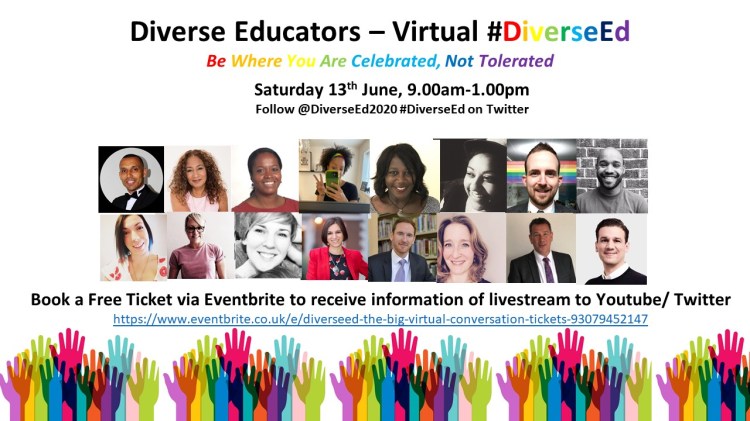
It is June 2020 and today we were due to be in Liverpool for our inaugural #DiverseEd North event. It was Patrick Ottley O’Connor’s pledge from our last event to host us to enable access in a different region. We have moved things on line and have collapsed hour long key notes and workshops into micro-presentations. We will be live streaming from 9am and the recording will be shared later on YouTube.

#DiverseEd Virtual Flier new new new

At 1pm we will be asking the 750+ who are booked to join us today for @DiverseEd2020 to make #MyDiverseEdPledge – 1 small thing that they can commit to as an individual, 1 thing they can impact, multiply that by 750 and our voices will be heard.

#MyDiverseEdPledge is twofold:

  1. To be a better Inclusive Ally. We can all do better. We can all be better.
  2. To challenge events which are not representative of the diverse communities we serve.

MyDiverseEdPledge

The future of #DiverseEd and plans we have on the horizon…

Autumn 2020:

We are planning a #DiverseEd student-centred event.

Autumn 2020:

We are working with a number of ITE institutions to ensure that Diversity and Inclusion is at the heart of curriculum for trainee teachers.

Autumn 2020:

We are planning a #DiverseEd event for the Independent schools sector who reached out to work with us.

Spring 2021:

We are planning to return to Slough for Diverse Educators IV, our 4th annual conference.

Spring 2021:

We will be relaunching our Diverse Leaders programme.

Spring 2021:

We are planning an Early Careers #DiverseEd event to address the biases in the recruitment system and support BTs, NQTs and RQTs and their mentors.

Summer 2021:  

We will be in Leeds for #DiverseEd North.

Other ideas from today:

We are talking about organising a diversity roundtable for ITE… a New Voices event for #DiverseEd and a Governors event for #DiverseEd…

We are also developing partnerships, raising funds and creating a platform to bring coherence and cohesion to diversity and inclusion in education. Watch this space!


#DailyWritingChallenge Day 65: Reflection

noun. the throwing back by a body or surface of light, heat, or sound without absorbing it; serious thought or consideration.
Reflection… Reflecting on reflection… Reflective practitioners… Reflective practice… Reflective teaching… Reflective leadership…
reflection 2
I have spent this week supporting my tutees from the PGCE I was previously in charge of. I left my salaried leadership role at the university at the end of April but I made a commitment to carry on supporting the individuals I had worked closely with all year. I am working freelance for the university and communicating regularly with my trainees, their mentors and my lead tutor.
It was important as the PGCE course leader to have my hand in and understand the mechanisms of the course. It enabled me to reflect on what was working, what was not working, what was needed and what could be improved. Much like when I taught as a Headteacher is also enabled me to walk the walk as well as talking the talk. I understood the pressures of deadlines and empathised with changing goalposts and the frustration of things being changed mid-year.
I love teaching and I love talking about teaching. I have always loved being a mentor and I have enjoyed being a tutor and acting as a coach for the mentors and their mentees. The tutor visits have kept me anchored in the system and I have enjoyed visiting a range of schools and sitting in lessons, giving feedback and having school dinners!
My cohort of trainees are from very different contexts. Trainee 1 had changed schools and deferred so had an extra term to do, I supported him until Christmas. Trainee 2  had extended due to personal reasons and had two more terms to complete, I supported her until Easter. Both were state secondary trainees in London. Trainee 3
and 4 both work at an international school in The Netherlands, one in primary and one in the middle school so I have been out to visit them twice and reflected lots on the IB programme and Dutch system. Trainee 5 works in an independent primary school in my region. Trainee 6 and 7 both work at the same secondary state school in South London, a school where I know some of their SLT. Trainee 8 returned from maternity leave and just needed to complete the final few tasks, I have not managed to meet her in person.
Eight very different teachers from very different backgrounds working in very different contexts. Trainee teachers working in Primary and Secondary, Independent and State, UK and International. Teachers of Geography, Maths, English, Computing, Music, Sociology, MFL and Science. Each had a very different journey to teaching and a very different experience of training as a teacher, but each had a shared sense of purpose and a shared vision.
As a remote learning course, our PGCE encourages our trainees to become reflective practitioners through a number of different ways:
  1. Reflecting on the reading of theory and how to apply it their own teaching
  2. Reflecting on lessons taught and responding to feedback from the observer
  3. Reflecting on lessons observed and considering how to magpie best practice from peers
  4. Reflecting through dialogue with their mentor in their weekly meetings
  5. Reflecting on how to evidence their progress and record this on their digital portfolio
  6. Reflecting on their tutor visits from me and my feedback on their progress on the course
  7. Reflecting on their termly progress through the writing of reports by the trainee, mentor and tutor
  8. Reflecting on their belief systems, purpose and philosophy of education through their Masters-level assignments
  9. Reflecting on the course’s core content through key note presentations to the whole cohort at our termly residentials
  10. Reflecting on their areas of development through their attendance at workshops they can opt for at our residentials

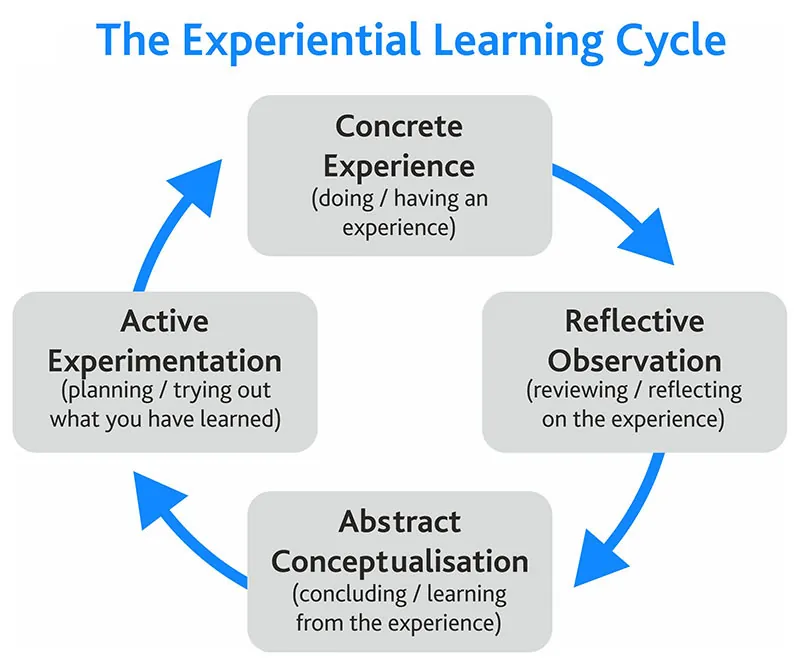
Reflection is a core component of any initial teacher training course and I have loved the process of working with them and teasing their reflections out of them. I have been lucky to have a very conscientious group who have been easy to work with. They are all human sponges and lap up feedback, they listen, they reflect, they assimilate and they improve. The theory our training model is based on is the Kolb Experiential Learning Cycle.

What Are KOLB's Learning Styles And What Do They Mean? - Skillshub.com

I have witnessed the journeys they have been on and I have seen this cycle be repeated across the teaching standards, repeated with different students and different classes, as they have identified areas for improvement and obstacles they need to overcome. My trainees have been reflective but they have also been tenacious.

Since lockdown I have been holding regular tutor clinics on zoom, an opportunity for them to come together as a group and chat about how they are getting on, a safe space to share how they are feeling and check in with each other. This has been an informal opportunity to reflect on how they are coping.

Their final PGCE residential had to be cancelled, so before I left I organised the remote delivery of sessions to aid their reflection in the final stage of the course. There was core content to still share, but I also had the opportunity to bring in some people from my network to deliver content I knew they would benefit from, including a Motivating Your Students session from Action Jackson, a Looking After Your Wellbeing session from Clare Erasmus and a session on PSHE and Citizenship from Mal Krishsanamy.

The course completion and final tasks have also been tweaked to reflect the changes in delivery style. So this week I have conducted a Viva with each trainee teacher. It has been an absolute privilege to spend an hour on zoom with each trainee capturing their reflections on their progress this year. My trainees are humble and modest, they could all reflect deeply on all of their growth areas, on what didn’t work and how they have worked hard to be better teachers for their students, but I have had to push them to be able to articulate their strengths and to celebrate their successes. I have encouraged them to reflect on the impact they have, how they have survived not only working full time, whilst doing a PGCE with Masters credits, but all of this during  a global pandemic. What a year to train to teach?!

I have also reflected this year on what it means to be an effective mentor. My biggest learning point in my year as Head of PGCE was that we do not look after our mentors very well. As a Headteacher I told parents that if I prioritised my staff’s wellbeing, then the children’s wellbeing would be served. My parallel thinking is that if we invest in our mentors, our mentors invest in our trainees. Alas, from everything I have seen and heard this year, through my reflections on what makes effective mentoring, our school system is doing our mentors a disservice, and we are thus doing our trainees a disservice. You can read my piece on mentoring for #CollectivEd here. Also, look out for a piece that David Gumbrell and I are writing collaboratively on our reflections on the move to remote/ digital mentoring and what this means for the trainee teachers too.

reflection 1


#DailyWritingChallenge Day 64: Agency – an anonymous blog

I woke up this morning looking forward to writing something for my first #DailyWritingChallenge piece. So I checked my twitter account and there was a message detailing today’s theme and a powerful blog about agency from the phenomenal Hannah. And as I was attending to my motherly duties, I couldn’t help but think about the different forms of agency that showed up in my life. I use my writing to exhale, to reflect and each time I write, I prompt myself to show up as my authentic self.

So here I go…..

Reading Hannah’s blog triggered a memory of a time I had no agency, a moment that changed my life forever and a decision that was a catalyst for the woman, the mother, the sister and the leader I am today.  When I was 8 years old, a decision was made to alter a sacred part of my anatomy in the name of culture. It took me a long time to grieve, understand, accept and celebrate this precious part of me. I never shared my FGM story before because I detest the pity and victimhood assigned to it by other women. This is irreconcilable with who I am, how I see myself and the uncompromising journey I took to get here. So what if my vagina looks different to yours? Does she need your pity?

NO, she doesn’t, she is a survivor, she gifted me with my children and she is the reason why I may be adding to that baby boom (please lord NO) in 9 months . The point is; I am not a victim, I am a survivor. In fact, how many can say they really know their most sacred part, that they’ve explored her, learnt to love and appreciate her reflection in the mirror and respect her enough to explore her needs. I know I have and I would encourage every woman to do the same. The point is I endured the outcome of no agency, I am not willing to endure the wounds of misguided collective agency or pity.

I may not have had ‘individual agency’ when I was 8 but I became an agent of change. My daughters and nieces will be the first women in our female lineage that will not be inflicted by a wretched cultural norm that has left many women in my community with scars that they are still healing from. And this makes me proud. It gives me hope, it fuels my purpose and my actions as a woman, a mother, a teacher and a leader.

For 13 years, I have had the honour to advocate for members of my community. For students who are judged and punished more harshly because of the colour of their skin. For mothers who needed guidance to navigate the structural biases of our education system and the unjust exclusion policies adopted by too many of our schools. For our youth who needed to see, as Shaun Wallace puts it, ‘GOAL’ models and required guidance about careers, HE choices and a safe space to explore their feelings. For a young community who is tired of the single story and the tabloid narrative and deserve representation, visibility and not to be seen through the lens of ignorance and structural biases.

That single fundamental moment of not having agency has shaped and impacted my life in so many ways, I am grateful it has given me the capacity to be an agent of change, to lead change and to:

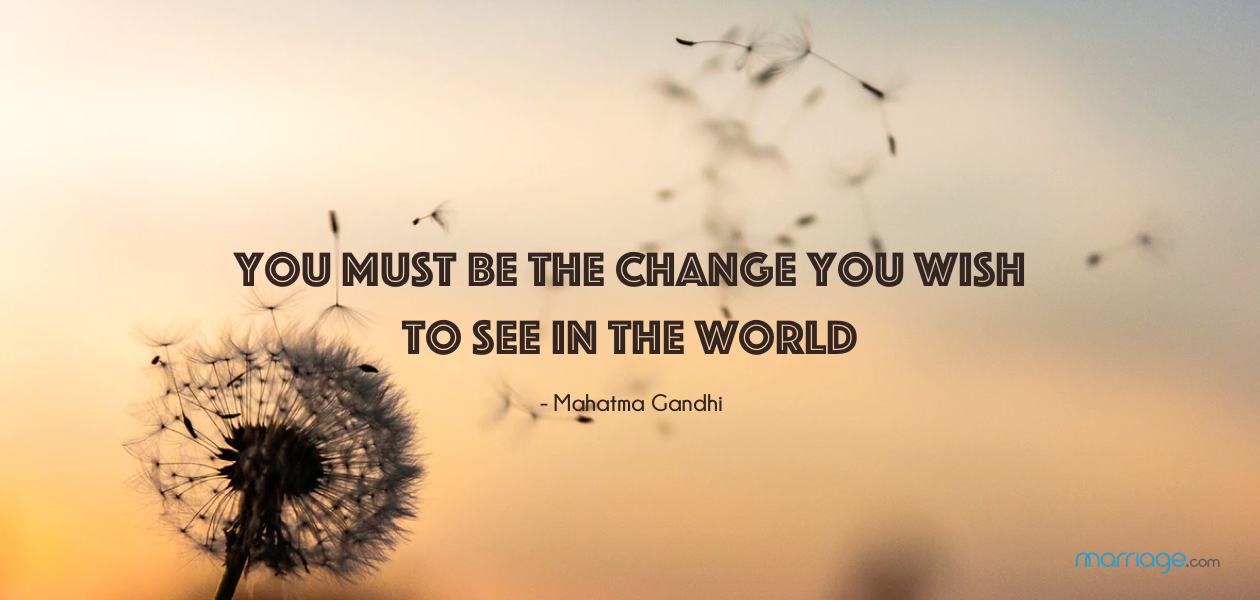
“Be the change you (I) wish to see in the world”

Mahatma Gandhi

Wishes Quotes - You must be the change you wish to see in the...

#DailyWritingChallenge Day 64: Agency

In social science, agency is defined as the capacity of individuals to act independently and to make their own free choices. By contrast, social structures are those factors of influence (such as social class, religion, gender, ethnicity, ability, customs, etc.) that determine or limit an agent and their decisions.

Agency = Action.

We need to have agency, we need to be agents of change, we need to act.

We need to deepen our understanding by listening, reading, learning and assimilating.

We need to raise awareness in ourselves and others, but then we need to be active in finding solutions.

“Awareness is the greatest agent for change”.

Eckhart Tolle

We cannot be silent. We cannot be passive. We cannot be bystanders.

We need to stand up, we need to speak up and we need to do the work.

“When we realise the degree of agency we actually do have, we no longer have to “hope” at all. We simply do the work”.

Derrick Jensen

Agency comes in many different forms.

Human Agency:

Human agency refers to the ability to shape one’s life and a few dimensions can be differentiated. 

As humans we have agency over our decision-making, over our behaviours and  over our actions. We are in control.
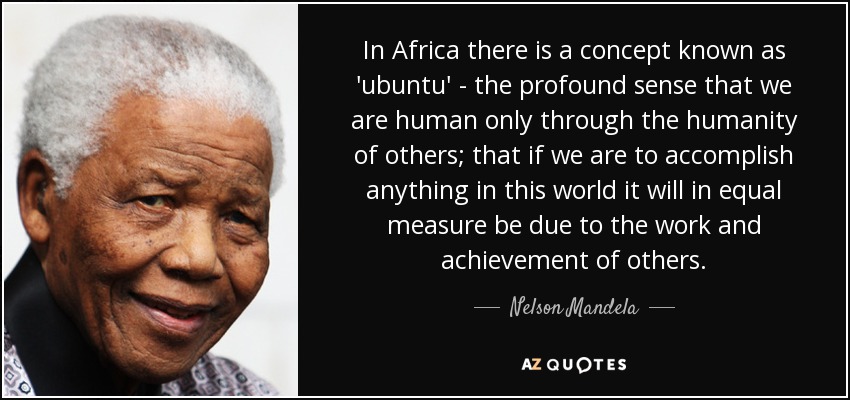
Nelson Mandela quote: In Africa there is a concept known as 'ubuntu...

Individual Agency:

Individual agency is reflected in individual choices and the ability to influence one’s life conditions and chances.

As individuals we have agency over our own lives. We influence what happens to us.

Collective Agency:

Collective agency occurs when people act together, such as a social movement.

In communities and in society we are stronger when we are united, when we come together as a cohesive unit, our message is more coherent and more powerful.

Institutional Agency:

Formal institutions—like schools, workplaces, and the government—teach people how to behave in and navigate these systems. Other institutions, like the media, contribute to socialization by inundating us with messages about norms and expectations.

Our Government shapes our society, our politicians shape our country and how we respond as a nation.

Our schools shape how we see the world, our curriculum shapes our knowledge.

Our workplaces shape how we experience the world, our cultures shape how we feel about ourselves and whether we belong.

Our media shapes how the world is represented, our journalists shape how stories are told.

Teacher Agency:

The capacity of teachers to act purposefully and constructively to direct their professional growth and contribute to the growth of their colleagues.

Teachers have agency over their own impact in their classrooms, they have agency over their own professional growth. In turn they influence the personal growth of the children we teach.

Student Agency:

Student agency refers to the level of autonomy and power that a student experiences in the learning environment. Student voice and agency are intrinsically linked. Agency gives students the power to direct and take responsibility for their learning, creating independent and self-regulating learners.

Our students are the leaders of tomorrow, our students are the product of our society, our schools and our agency as adults and teachers.

To have agency:

To have control over something means that control has been achieved. To have agency over something means that one has the ability or authority to achieve control. 

We all have a sense of agency, but we need to decide if it is passive or active. We need to choose the focus of our agency and what to prioritise.

Your agency:

Your ability to take action, be effective, influence your own life, and assume responsibility for your behavior are important elements in what you bring to a relationship. 

We choose what we bring to a relationship. We choose how we show up. We choose whether we stand up or speak out. We choose to be bystanders or upstanders.

Change Agents:

A change agent is a person from inside or outside the organization who helps an organization transform itself by focusing on such matters as organizational effectiveness, improvement, and development. A change agent usually focuses his efforts on the effect of changing technologies, structures, and tasks on interpersonal and group relationships in the organization. The focus is on the people in the organization and their interactions.

We all have the capacity to lead change. We can all be the change we want to see in the world.

YOU be the change you wish to see in the world | Craig's Quotes

Last night, June 10th, a group of women came together from their shared sense of agency. #ICantBreathe was an event by women, for women. The title of the event spoke to the tragedy of George Floyd’s death. He couldn’t physically breathe, a black man oppressed by a white patriarchy.

Women of colour cannot breathe metaphorically, they are holding their breath, they are struggling, they are suffocating, they are in pain. We apologise if our choice of title triggered trauma in anyone, that was not the intention.  We wanted to make sure that the voices of women of colour in education are heard, are listened to and are amplified amidst the global #BlackLivesMatters protests.

Alison Kriel, Angie Browne, Amy Ferguson, Penny Rabiger, Hannah Jepson, Jules Daulby and I, pooled our individual agency and stood together with our collective agency. We brought together hundreds of women, women from all walks of live, to create a collaborative safe space to support women of colour. It was a call to arms.

Each woman, representing different grassroots communities: #BAMEed, #DisabilityEd, #DiverseEd, #LGBTed, #NourishEd and #WomenEd shared their story. Each woman spoke their truth.

The stories were painful. The stories were emotionally charged. The stories made us feel uncomfortable.

“There is not greater agony than bearing an untold story inside you”.

Maya Angelou

Angie shared her story as a woman of colour, a mother and encouraged every woman attending to find and to use their voice.

Amy spoke about what it means to be an inclusive ally and encouraged every woman present to stand up, to speak out and to challenge.

Alison spoke about the struggle in raising your voice in a workplace where noone is listening and gave tips on how to make yourself heard.

Penny spoke about practical ways to keep yourself and others safe, physically and emotionally.

Black women, brown women, white women, straight women, queer women, able-bodied women and disabled women came together. We sat together and we listened, we learned about what is like to be a woman of colour, we learned about how to navigate the structural biases that are impacting a sense of safety.

We had 1,000 women booked to attend but due to a technical glitch we managed to livestream to 500. The recording will be shared for those who could not access the event. It is temporarily held here but will be moved.

We have started a new twitter handle to keep the conversations going. Follow #CollaborativeSupportForWomen and @CollabSupport

The safe space became a public space. The private conversation became a public conversation. The individual voice became a collective voice. The individual agency became a collective agency.

Agency = Action.

If each person who attended commits to doing one thing today then we become part of the solution, we stop being part of the problem.

Butterfly Effect | The butterfly effect quotes, Theory quotes ...

We need to have agency, we need to be agents of change, we need to act.

If each person who attended shares what they heard, what they learned  they create a ripple effect in their sphere of influence.

We need to deepen our understanding by listening, reading, learning and assimilating but then we need to do the work.  

If each person who attended forwards the recommended reading on to their friends, family and colleagues, we raise awareness and reduce the ignorance.

We need to raise awareness in ourselves and others, but then we need to be active in finding solutions.

If each person who attended shares the BAMEed risk assessment with their Senior Leaders, we contribute to keeping our black and brown colleagues physically and psychologically safe.

We cannot be silent. We cannot be passive. We cannot be bystanders.  

If each person who attended stands up, speaks up and speaks out, and refuses to be a bystander to racism, we move from being non-racists towards becoming anti-racists.

Let’s all be agents, let’s all take action, today, not tomorrow, as tomorrow may be too late.

“Agency is your power to become.

Each choice takes you further from what you are meant to become”.

Randall Ridd


#BlackLivesMatter: Imagine if racism had a scent – an anonymous Blog

Imagine if racism had a scent, imagine the odour, imagine the stench. Would you still be able to sit next to those colleagues who say things that are racially off?

For most of my career in education I worked in schools with a high percentage of BAME students and some of you might have already guessed what my next observation always was; the majority of teachers and SLT were always white.

BAME staff were usually over represented in non-teaching and pastoral roles as if they were the only ones that could manage behaviour. Although, this was true in some of these schools; I would argue that they were not necessarily the only ones who could manage behaviour but they were better at connecting with the kids. We could explore how race and representation are the key factors in this but that’s for another essay.

I am Black, Muslim, an Immigrant and a Woman. So it may not be a surprise to some that I have dealt with the whole spectrum of hate and prejudice throughout my life. From that unconscious bias to the, in your face, overt racism; ‘go back to your country’!

My black friends and I often talk about the microaggressions we experience at work and I have experienced far too many to count. However, I don’t know which is worse, the microaggressions, the implicit subtle forms of racism or the blatant (in your face) overt racism. I know which I prefer.

Let me see if I can explain my thinking…

I don’t like BS, I’m not a subtle person, I’m not subtle in expressing my views, or my identity and I am definitely not subtle when dealing with hateful people. I prefer knowing who my enemies are. I do not always have the time or energy to decipher between the gems, the snakes and the fake allies; although life has not always spared me from mistaking a snake for an ally.

I earned the nickname “red hot pepper” in the earlier years of my career because I would literally go red during exchanges with colleagues who thought they could spill their prejudices and hate in my presence. This was exhausting, looking back I wonder where I got the energy from.

Let me give you some examples of my experience as a Black Muslim woman in my beloved profession.

I once expressed my desire to get parents and the local community (my community) more involved and enthused about prom. The reply from one of my colleagues was “phuhh….not in this area, we will need knife arches because all THEY would bring are knives, guns and drugs’. You can imagine my reaction; I was fuming and challenged this colleague’s racist remarks only to be gaslighted and made to feel as if I was being paranoid. And when that tactic failed, this colleague walked away.

I have been called ‘aggressive’ by colleagues and referred to as ‘that feisty black teacher’ by students. When I discussed this with an SLT member of staff, an ally, she recognised that Black women’s passion is often mislabelled as aggression. She compared this with how assertive female leaders are labelled as a ‘bitch’ whereas the same characteristic in a male leader is celebrated as a strength. This is not the same but I appreciated her efforts in letting me know that she heard me. I then discussed this with my year 13 class and the response I received from one of my students left me bewildered. This young man was confident and comfortable in expressing his views that black women are naturally feisty and can be difficult. I asked him how he would describe another well known white female teacher in the school. He said ‘strict’. Shocked by his response, I asked him to elaborate and explain how he came to his conclusion. His reply was ‘I can’t really explain it, but there is just this way about black women and the way you say things when you are telling us off , there is a certain attitude to it.’ It was at this point that two BAME students stepped in and called him out on his bias. What followed was a very lively and enlightening discussion on race and racism. It is important to note that my KS5 classes have always been safe spaces for students to be able to have an honest discourse about all sorts of things. The spaces and environment I created took time. There was trust and respect. They trusted me as their teacher and they knew I had the patience to engage their minds and encourage critical thinking. This is by far my favourite age group to engage about their views on race and racism. I have all the time in the world for them.

Then there are the countless arguments with colleagues who misinterpret the confidence of black children as arrogance. Some teachers are too quick to dismiss the passion and voices of black children as defiance, bad attitude, back chat, poor behaviour and threatening . I am tired of the endless attempts to silence and vilify black children’s voices. As a parent and a teacher, I vow to continue to fight against what I call; the disempowerment of little brown and black human beings. This earned me the title of ‘the most informed parent’ by my children’s head teacher. In another word….’a trouble maker’ but I chose to interpret that to mean that I’m doing my job well as a parent and holding them accountable. And I am okay with that.

Moving on…

Then there is that time I was the only Black person in my team. This was probably the most challenging and taxing period in my career. I believe I physically aged in that year. I was new to the school so I had to deal with the usual challenges of being the new member of staff and newest member of my team. But things went from bad to worse once I proved myself and earned the praise of SLT. My confidence compounded my team’s hate (I know it’s a strong word but that’s how I felt at the time) and escalated their attempts to make me look incompetent but GOD sent me angels who had my back. Their sabotaging included holding back key information, siding with each other when making decisions and telling my line manager and other colleagues that I was doing a poor job. They excluded me from their what’s-up group and to rub it in, they’d have discussions with me about the shenanigans that go on in their group chat. My line manager was part of this group. We would have these heated clashes about the racist and stereotypical statements they’d make. For example, sweeping statements such as knife crime is ‘a black on black’ crime.

During Ramadan they actively encouraged students to break their fast when the students complained about being tired. I remember how huge this argument was and how they tried to gaslight me and make it seem as if I was being too sensitive. They would stereotype students based on their ethnicity and culture. I remember thinking, these are the people we entrust our kids with. Were they racists? Were they horrible human beings? I would like to answer no to both of these questions but I really can’t say. What I can say is they did have some good qualities but their unconscious bias or racist attributes will always taint any good deeds or intentions they had as educators.

I remember how draining and unhealthy it was to always be on guard and to second guess all their moves. It was a toxic environment and I was exhausted and even considered leaving. But I am a stubborn person and my pride would not let me quit. Plus I am a true believer that what was meant for me will never miss me and that what misses me was never meant for me.

So I accepted that I was hated (Strong, I know, but that’s how I felt at the time) by my team but loved by so many others, especially my students. So I leaned in on that and used it to anchor and fuel me. I established myself and built my tribe from outside of my team. ‪I vented to my support systems and sought the counsel of the strongest and wisest people I know. And after talking to my mum and dad, I knew I deserve to be at that school. I was making such an impact and this was visible to everyone. Plus my students deserve to have me there.

So I decided to continue being me, rocking the boat and being that positive disruption that I believe was needed in that school. I let them watch me everyday as I moved with kindness and integrity. I leaned in on my faith, prayed, trusted my creator’s plan. I stood my ground, held my head high and continued being led by my moral purpose.

Being the newbie at work is never easy. The process of having to prove yourself all over again can be frustrating. Then there is the time it takes to find your tribe, that group of people that just gets you, it feels like you have known them your whole life. But when you add racism to this mix, it really can be detrimental to a person’s mental health and hinder their career.I believe I survived and thrived in this situation and every other situation, where racism reared its ugly head, because of two things; one is my faith, I believe in divine decree and the other is my support systems. I consciously lean into the strength I get from both of these elements. My determination, resilience and tenacity are indebted to my support systems outside and inside of school.

If racism had a scent, I believe it would be foul, so foul that no one would be able to sit next to our colleagues in some of our schools. I don’t think we would be able to continue what most currently do, which is awkwardly laugh, pretend it is not happening or walk away but later wish you had said something.

“It is not enough to be quietly non-racist, now is the time to be vocally anti-racist.”  Unknown

So please, oh please, challenge your colleagues next time you hear them saying something that is prejudice, bias or racist. I urge you to hold them accountable and remember he or she is meant to be an educator, a teacher and loco parentis.


#DailyWritingChallenge Day 63: Fragility

Fragility: noun. the quality of being easily broken or damaged; the quality of being easily harmed or destroyed. 
 
Life is fragile. The world is fragile. Humanity is fragile.
When I think of fragile things I think of  bubbles, snowflakes, panes of glass, flowers, butterflies, glass baubles and dandelion clocks.
Fragile, delicate things. Things that break easily. Things that shatter.
She wasn't fragile like a flower she was fragile like a bomb ...
The universe has spoken in the last few months and reminded us of the fragility of our lives, our world and our humanity.
We have been reminded that we are not in control. We have been reminded that life is short. We have been reminded that we will all die one day.
I have always been afraid of death. I had nightmares as a child about it. I would wake myself up crying, scared of people around me dying.
As a 41 year old I have surprisingly never been to a funeral. I have attended just one memorial for a friend who died of cancer when we had just finished university. Her body succumbed to the illness on her third wave as it crept into her spinal cord.
Synonyms for fragile include brittle, breakable, flimsy, weak, frail, delicate and eggshell. For fragility we can interchange frailty, weakness, delicacy and vulnerability.
I sometimes wish we could wrap our loved ones up in cotton wool, put them in a bubble to protect them from harm.
Thinking about the calcified shell of an egg, I wonder about the scientific wonder of a brittle layer, holding life within. Protecting the inner contents from force, desiccation and danger.
Fragile things need to be guarded, they need to be treated with care. One careless touch can irrevocably damage that state of a delicate object.
Kim Edwards Quote: “Lately, the world felt fragile, like a blown ...
But then we come to white fragility. A term that has become part of the common parlance in the #BlackLivesMatter narrative.
Unlike, the delicate, beautiful, fragile objects we need to preserve and protect, white fragility, to the converse does need shattering.
White Fragility: noun. discomfort and defensiveness on the part of a white person when confronted by information about racial inequality and injustice.
11 Ways to Avoid Triggering White Fragility
In 2011, Robin DiAngelo coined the term “white fragility” to describe the disbelieving defensiveness that white people exhibit when their ideas about race and racism are challenged—and particularly when they feel implicated in white supremacy.
I repeat: Life is fragile. The world is fragile. Humanity is fragile.
Yet, we have an issue. We seem to be more uncomfortable in being party to a  conversation about racism, than we are about the act of racism itself.
All human lives are fragile, there is not a hierarchy of some lives being of more value than others. We live in the same world, but some parts are more fragile than others. Some inhabitants exist in more delicate and more fragile situations than others. Humanity is fragile, but there is a scale of fragility. We will all die, but we do not all fear death and danger, day in and day out.
We, as white people,  need to educate ourselves on our whiteness. Words I am reading, seeing and hearing regularly that need unpacking:
White privilege: white skin privilege refers to societal privilege that benefits white people over non-white people in some societies, particularly if they are otherwise under the same social, political, or economic circumstances.
White supremacy: is the racist belief that white people are superior to people of other races and therefore should be dominant over them.
White power: a white supremacist slogan designed to mimic the “black power” slogan often used by African-Americans in the 1960s/70s. It is a commonly shouted at white supremacist events as a racist rallying cry.
White silence: white silence is experienced by members of the White culture who, during discussions of racial issues, experience negative emotions including guilt and anger. When these feelings are not addressed, Whites begin to resist certain content areas. This resistance takes on the form of White silence.
White allies: a white ally acknowledges the limits of her/his/their knowledge about other people’s experiences but doesn’t use that as a reason not to think and/or act. A white ally does not remain silent but confronts racism as it comes up daily, but also seeks to deconstruct it institutionally and live in a way that challenges systemic oppression, at the risk of experiencing some of that oppression. Being a white ally entails building relationships with both people of color, and also with white people in order to challenge them in their thinking about race. White allies don’t have it all figured out, but are committed to non-complacency.
White tears: The phrase has been used to gently tease white people who get upset at things they think threaten their white privilege. It’s been used to poke fun at white people who think that talking about race makes you a racist.
Whitesplain: ‘splain’ has since become an affix signifying a patronizing, condescending explanation, usually given by a person in a privileged position. Whitesplain, then, is when a white person explains a topic, often concerning matters of social justice or minority culture, in an overconfident, often inaccurate manner to people of color.  (A new one I heard for the first time this week is: “PrivSplain”)
White panels: white people need to get better at seeing race, addressing it, and addressing our own complicity. Taking part in all-white panels – especially on a subject where race is central – simply isn’t good enough.
Other phrases that are showing up repeatedly that we also need to consider the significance and connotations of are: White pillars. White solidarity. White equilibrium. White racism. White progressives. White hostility. Colour Blindness.
White people are still raised to be racially illiterate. If we don ...
Why is it so hard for white people to talk about racism?
This is the question posed by academic Robin D’Angelo in her book “White Fragility”. Her research exposes racism in thought and action – it is a call for humility and vigilance.
“The problem with white people,” she says, “is that they just don’t listen. In my experience, day in and day out, most white people are absolutely not receptive to finding out their impact on other people. There is a refusal to know or see, or to listen or hear, or to validate.”
Robin D’Angelo

I have seen a lot of white people get very uncomfortable about what to do and what to say in the current context. Conversations about racism will cause discomfort and defensiveness. Our focus and attention should be on the discomfort of others, our defence should be of lives not egos.


We, as white people, need to get comfortable with being uncomfortable, that is how we listen, we learn and we progress.


We, as white people, need to stop being part of the problem, and we instead, need to start being part of the solution.


We, as white people, need to put our disbelief and sensitivity to one side and we need to be aware that we are complicit in society’s institutional racism.


Being silent is not enough. We need to be anti-racists rather than non-racists. We need to be active not passive in our commitment to ensuring that everyone is seen, everyone is heard, everyone is valued.


We have had a wake-up call, and we need to put our fragility to one side, and respond.


We need to check our privilege and we need to commit to being better, to doing better. One thing I am going to commit to continuing to do is calling out all-white line ups.


As women we have critiqued all male line ups at events, but as women now penetrate more panels and their voices are heard in more spaces, we need to make sure that white women are opening the door for brown and black women to step in and share that space. I am seeing too many influential white women in education accepting to speak at events where there is not diverse representation. This is not good enough.
We need to pop the bubble we exist in.
Brene Brown has started a campaign this week called #ShareTheMicNow to model how to do that.  Please check it out.
Actresses, Activists To Magnify Black Women Voices' In ...

#DailyWritingChallenge Day 62: Energy

In physics, energy is the quantitative property that must be transferred to an object in order to perform work on, or to heat, the object. Energy is a conserved quantity; the law of conservation of energy states that energy can be converted in form, but not created or destroyed.

There are 8 different types of energy including: thermal energy, radiant energy, chemical energy, nuclear energy, electrical energy, motion energy, sound energy, elastic energy and gravitational energy.

I am a high energy person. I embrace life with zest and I run at it. I lean all in. My life is busy and full. I have created self-care rituals and wellbeing routines over the years to restore me but during lockdown the fatigue has been different and what renews me has needed to change.

“Passion is energy.

Feel the power that comes from focusing on what really excites you”.

Oprah Winfrey

The last 12 months has been full on. Buying a house, leaving Headship, going travelling, starting a new job, driving a long commute, doing my MA have taken their toll. Exasperated by events and situations that have drained my emotional energy. My physical, emotional and mental energy levels have needed my regular attention to keep me going. 

Lockdown came as a welcome break, it forced me to pause, to be still and to slow down. It came at a good time for me as I worked my notice and prepared to go it alone. It has allowed me to gain energy and time to invest in my new endeavour, it has given me the opportunity to focus and to reflect.

Hitting the ground running on May 1st I have been busy – busy following up conversations about new opportunities, agreeing projects and contracts. I have given my time and energy quite generously, I support others and I do a lot for free. My relationship with me as a resource is going through a new iteration, my time and energy are now my resource for making my living and I need to make sure I prioritise and do not spread myself too thinly.

It is flattering that lots of people want to connect with me, want to talk to me, want to collaborate with me and want to work with me, but each conversation takes up time and energy. Each time someone reaches out to me or is introduced to me I have another demand placed on me and this is how my energy begins to be drained. I am a connector but I can quickly become overwhelmed and over-stretched. I am juggling lots of communications on lots of platforms and am considering how to filter/ streamline. I am also reinforcing that twitter DMs and whatsapp messages about ‘work’ stuff out of hours need to be emails in working hours.

Most people are living at such a furious pace that they rarely stop to ask themselves what they stand for and who they want to be. As a consequence, they let external demands dictate their actions. HBR

Last week I hit a wall. I crashed and burned. My energy levels  hit an all time low, my tank hit empty. I have noone to blame but myself. Compounded by low iron levels fatigue kicked in.

So, I forced myself to step back for a few days, I withdrew to reflect and restore. I have revisited self-care rituals that have served me in the past and I have reinforced boundaries that protect me.

As Brits we are obsessed with how we manage our time, but other cultures are more interested in how they manage their energy. I can remember reading a really interesting article in the Harvard Business Review a few years back about it, and how by changing the focus lead to higher levels of productivity.

Time management may give you the time to spend with them but energy management ensures that the time you spend with them is quality time. Energy management works by ensuring that you take time between each sprint (your most important work), to rebuild your energy levels. HBR

I like the analogy of “Life is a marathon, not a sprint” which is a parallel message to the fable of the Tortoise and the Hare.

The ultimate message is that we need endurance and willpower to finish what we start. We need to plan our resources, our time and our energy, to cover the whole distance. We don’t want to crash and burn at the first milestone.

“The secret of change is to focus all of your energy, not on fighting the old, but on building the new”.

Socrates

So I am revisiting and reviewing my time management strategies v my energy management strategies. I am giving myself the advice I often give to others!

Some wisdom:

  • I need to take time between each sprint to rebuild my energy levels.
  • I need to remember that my time and energy, like money, are precious resources.
  • I need to manage me as carefully as I project manage everything else.
  • I need to reflect on my relationship with productivity and success.
  • I need to pace myself.
  • I need to protect myself.

If this is resonating here are some questions to reflect on to encourage you to implement energy management:

  • Do you know what energises you?
  • Do you build breaks into your workflow?
  • Do you break big projects into manageable chunks?
  • Do you celebrate each milestone that you achieve?
  • Do you schedule spending time enjoying the things that you love?

I am energised by listening to music, talking to friends, being outside and being purposeful. I am energised by being in flow.

I am restored by sitting still, being quiet, lying on my shakti mat, standing in my garden, going for a stroll, lying in the bath and taking a power nap.

“Everything is Energy and that is all there is to it. Match the frequency of the reality you want and you can not help but get that reality. It can be no other way. This is not philosophy. This is physics”.

Albert Einstein

I am going to commit to myself that I am going to regularly do an ‘energy audit’. I am going to reflect on my four energy dimensions: body, emotions, mind, and spirit and consider what I need to be physically, emotionally, mentally and spiritually energised.

My body is best looked after when I walk lots, eat healthily, drink more water than gin and when I sleep well. I am good sleeper, I go to bed early but I need 8 hours to be rested and I have been waking up really early recently and I need to break this habit!  I need to pay closer attention to preserving my physical energy.

My emotions are best looked after when I have a coach so I have reconnected with mine and am going to build in that time to focus on processing the change I am going on. I am also looking into supervision as I listen to a lot of people and I carry a lot of emotions for others which I need to process. I need to pay closer attention to the quality of my emotional energy.

My mind is best looked after when I am focused and purposeful. I concentrate well but I need to filter out the white noise, I need to be less accessible and I need to prioritise strategy. To enable me to focus I am going to get a Virtual Assistant so that they can filter my communications and streamline my emails and phone calls. My VA can chase overdue invoices and do some of the heavy lifting for me which is weighing me down. I need to be more mindful of my mental energy and be less wired to be ‘on’ all the time.

“The energy of the mind is the essence of life”.

Aristotle

My human spirit is best looked after when my energy is invested in my meaning and purpose. I fully embrace living life authentically and embodying my core values, but my values are being compromised by the world right now. I am feeling deeply affected by the values clash in humanity. I am spiritually energised when I am in flow, in my sweet spot, when my personal priorities are in alignment and when I am fulfilled. I serve my spiritual energy through voice and agency, but I need to remember this is a collective endeavour and it is not my individual responsibility.

So, if like me, you are headed for an energy crisis, consider the cycle of how your life, reflect on your day-to-day existence and plan in your recovery. As humans, we need to be better at effectively managing our resources, we need to focus on managing our energy, not our time.

I am also reflecting on what gives me positive energy and what projects negative energy. I am planning how to manifest more/ less of this in to each day. I am breathing slowly, showing appreciation and changing the story I tell myself about what is going on.

In an organisation recovery and renewal efforts should be planned for, they need support and commitment from leadership and they need to engage the decision making stakeholders. Some businesses have created “renewal rooms” where people can regularly go to relax and refuel.

As an individual working independently, I need to hold myself to account and create this renewal and recovery process for myself. I need to manage my energy, so that I can channel it into influencing the things I am passionate about. I am no good to anyone if my energy is zapped.

energy 2